Food & Drink
Learn how a French Organic food producer uses Farleygreene’s Segregator 42 for extruded protein screening, grading and oversize removal.

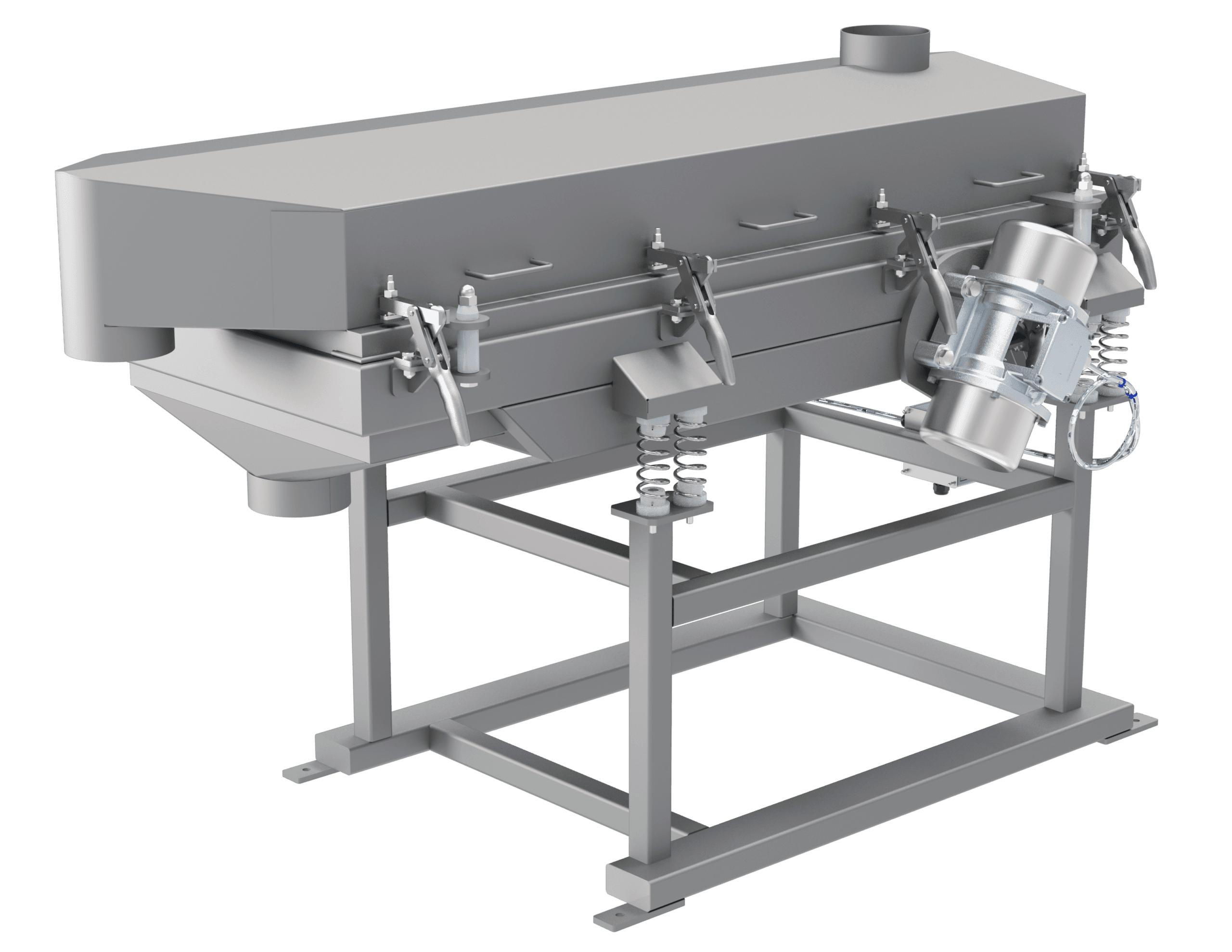
Farleygreene supplied a Sievmaster© Segregator 42 to help a leading French organic food producer grade extruded plant proteins and separate oversize material while protecting delicate products.
Delivered with French Distributor Tripette & Renaud, the solution addressed the producer’s need for reliable grading, product integrity and support for ambitious production growth plans.
The project was delivered through Farleygreene’s long-standing French distributor, Tripette & Renaud, who introduced the opportunity and provided technical support throughout the specification process.
The end user is one of France’s leading organic agriculture businesses, with more than fifty years of experience producing 100% certified organic products. Working with a network of approximately 200 certified organic farmers across north-west France, the company sources legumes including peas and fava beans for use in a range of value-added protein products.
A significant part of the company’s operation involved protein extrusion, a process that uses heat, pressure and mechanical energy to transform plant proteins into functional ingredients and meat alternatives, including texturised vegetable proteins (TVP). The resulting products are used in a wide range of food applications, including meat substitutes, snacks, cereals and pet food. Many of these products are sold as texturised vegetable protein (TVP) ingredients for use in plant-based foods.
As production volumes increased, the customer required a screening solution capable of maintaining product quality while supporting long-term capacity growth and meeting the rigorous standards expected with organic food manufacturing. Reliable plant protein screening would be critical to maintaining product consistency as production scaled.
Tripette & Renaud, Farleygreene’s trusted French distributor, facilitated an introduction to one of France’s foremost organic agriculture companies. With more than fifty years in the industry, the business has earned a strong reputation for its specialist knowledge and commitment to producing 100% certified organic products.
Our client uses extrusion – a controlled process using heat, pressure and shear force – to emphasise the final products’ texture, moisture content, flavor, and visual appeal. This is a groundbreaking approach to organic food alternatives and is effective in a multitude of applications, such as pet food, snacks, breakfast cereals and meat substitutes.
Sourcing organic ingredients from north-west France such as various legumes, including peas and fava beans, the customer works with a network of around 200 certified organic local farmers. Guided by core values of sustainability and transparency, they needed exceptionally engineered equipment that matched their quality standards and protected the integrity of their products.
The customer required a robust sieving solution capable of continuous operation in a demanding food production environment and able to support its projected five-year growth target of 3,000 to 4,000 tonnes of plant-based ingredients.
The application involved grading extruded protein after processing at ambient temperature and atmospheric pressure. Produced at varying particle sizes and conveyed under flood-feed conditions, the material needed to be screened accurately while maintaining product integrity and ensuring reliable handling of significant oversize fractions.
The customers key objectives were to:
• Deliver a consistent, high-quality final product
• Accurately grade extruded proteins into the required particle size fractions
• Reliably remove oversize particles and agglomerates
• Handle a high percentage of oversize effectively under flood-feed conditions
• Meet food-grade and organic production requirements
As the equipment would be in direct contact with dry food ingredients, the selection of food-grade screening equipment compliant with EC 1935/2004, was an essential part of the specification.
The customer originally identified the Multiscreen range as a potential solution, due to its grading capabilities. However, following a detailed review of the process requirements by Farleygreene and Tripette & Renaud, it became clear that the Sievmaster© Segregator 42 was the more suitable option.
The Segregator’s linear vibratory motion and large screening area make it particularly effective as an industrial food screener for light, fragile materials with low bulk density. These characteristics closely matched the behavior of the extruded protein, enabling efficient separation while minimising unnecessary product handling.
To achieve the required grading performance, a 5,000 micron woven SS430 mesh was specified across a 1,280 mm x 640 mm screening surface. This configuration provided reliable separation of oversize material while allowing correctly sized product to pass efficiently through the process.
The selected machine also met the site’s compliance requirements, giving the customer confidence that the equipment could be safely integrated into its food manufacturing operation.
The Sievmaster© Segregator 42 was successfully integrated into the customer’s production line and continues to provide reliable, repeatable screening performance.
It’s linear vibratory motion and large screening area have proven particularly effective in processing extruded proteins, enabling consistent removal of oversize particles and agglomerates while maintaining a homogeneous final product. The machine also supports the processing of materials where moisture variation can contribute to clumping, helping maintain screening efficiency throughout production.
Key benefits achieved include:
• Consistent grading of extruded proteins across varying particle sizes
• Effective oversize particle removal and agglomerate separation
• Reliable operation under flood-feed conditions
• Preservation of product quality in line with the customer’s standards
• A screening solution capable of supporting future production growth
According to Daniel Morlan, Global Sales Manager at Farleygreene:
“Following installation, feedback from the customer has been very positive. They reported that the Segregator was performing well and recognised clear advantages over the alternative machine originally under consideration.”
The project demonstrates how thorough application assessment and close collaboration between Farleygreene and Tripette & Renaud helped identify the most appropriate screening technology for plant-based food manufacturing, ensuring reliable performance and product quality for a growing plant protein producer.
Need Help Screening Plant Proteins?
Whether processing texturised vegetable proteins, plant-based ingredients, powders or granulates, Farleygreene and its global distributor network can help identify the most suitable screening solution for your application.
For customers in France, please contact Tripette & Renaud:
Christophe Villeroy
[email protected]
Or contact Farleygreene directly:
📞 +44 (0)1256 474547
[email protected]
A global vanilla powder manufacturer invested in a new Sievmaster Ultrasonic System, to achieve a throughput increase of up to 50% and reduce waste of good product.
A prominent brand in the coffee industry required a new sieve at one of their European plants to achieve a throughput of 2000kg per hour.
Food & DrinkMarket leading quartz surface manufacturer ensures the quality of their final product with Farleygreene's Sievmaster 500-S batch sieve.
 Chemical
Make use of our demo fleet with two-weeks for free, or our in-house testing facility.