


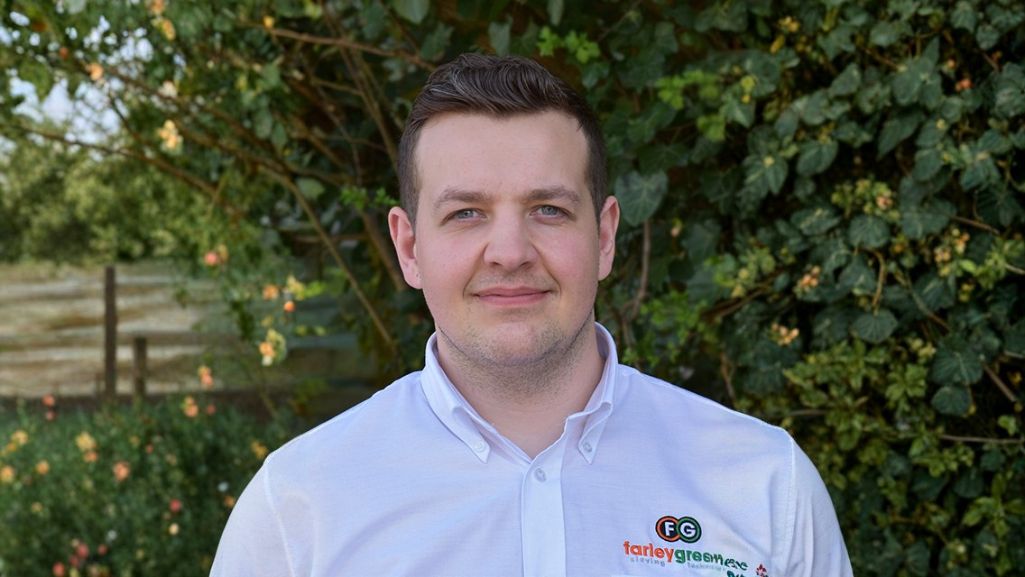
Luke Wilcox joined Farleygreene ten years ago as a graduate design engineer. Since then, he has held almost every technical role in the business – design, certification, quality, and now manufacturing operations. That breadth of experience shapes how Farleygreene’s equipment is built, checked and delivered to customers with the most demanding process and hygiene requirements.
A career built across every technical discipline
Luke arrived at Farleygreene straight from his engineering degree and moved quickly into senior design work – developing both standard product designs and bespoke configurations for customers with specific process, hygiene or installation requirements. Feed inlet positions, frame mounting arrangements, cleaning access points: all of it designed from the outset to meet the hygiene standards demanded by food and pharmaceutical production.
From design, Luke moved into the technical and certification side of the business, taking responsibility for ISO 9001 compliance and QAN audits, ATEX certification, and the regulatory documentation that underpins every machine manufactured by Farleygreene. The role required him to demonstrate not just that individual products were safe, but that the company’s processes were too.
A period as Quality Manager followed: overseeing goods-in inspection, supplier management, customer complaints, and the technical files required for external certification of every machine as well as Farleygreene itself.
“Working across design, certification and quality has given me a really clear understanding of the high standards we must meet with every sieve machine we produce. It means I approach manufacturing with a constant drive to produce the best.”
Taking manufacturing in-house
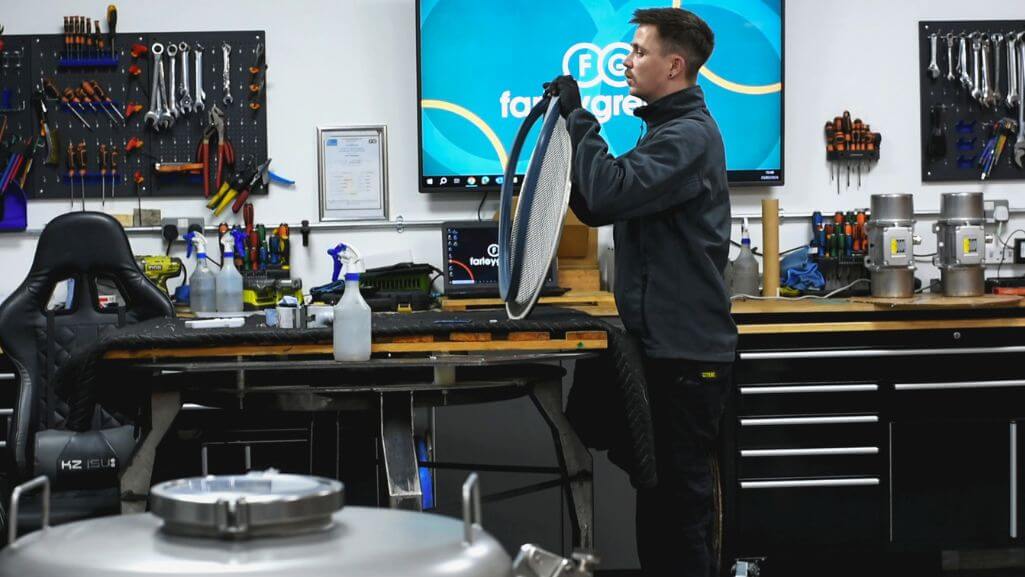
Farleygreene sieving machines have always been manufactured in the UK, but until recently, Farleygreene relied on subcontractors for many components, with final assembly carried out on-site in Hampshire. Now, the team are bringing fabrication in-house, driven by growth, greater ability to control quality, and the need for faster turnaround. Today, Luke manages a team of five specialist welders, alongside inspection and an expanding range of on-site fabrication equipment.
As Luke confirms, the shift has been significant for customers as well as the business. With design and manufacturing under the same roof, the feedback loop between the engineering team and the workshop is immediate.
“Design queries get resolved in hours rather than days. Bespoke requirements can be prototyped, checked and refined without the delays that come with external suppliers. And costs passed on to customers are meaningfully lower.”
Why welding quality is key
Hygiene standards and the ability to keep machinery clean are critical in sectors such as food, pharmaceuticals, and chemical processing. Maintaining hygiene standards in sieving operations depends on much more than the design of the sieve: the quality of every weld on the finished product is crucial.
Farleygreene manufactures exclusively in 316 stainless steel, a premium alloy renowned for its superior durability and outstanding resistance to corrosion and the industry standard for hygienic applications. But the material choice is only part of the story.
Luke’s welding team works across MIG, TIG and laser welding processes, depending on the joint, the application, and the hygiene requirement – which extends beyond the generic standard of general fabrication.
“You can look at machines from other suppliers and see where the detail hasn’t been followed through. Welds that aren’t properly joined, surfaces that haven’t been finished correctly. Our guys take real pride in their work – tight seam welds, good fabrication, an eye for detail. It looks better, and more importantly it performs better in a hygienic environment.”
A fill-in weld used to compensate for poorly fitting components may appear to close a gap, but the resulting surface can lack the smooth, continuous finish required for effective hygiene and cleaning. In a food or pharmaceutical environment, that is not acceptable. Strength and durability can also be compromised if corners are cut in this advanced manufacturing sector. Luke’s team is trained to fit components accurately before welding, giving the highest level of protection and resilience.
The same high standard across every sector
Farleygreene supplies sieving equipment across sectors including food and drink, pharmaceutical, chemical, and additive manufacturing. The manufacturing standard applied is consistent across all of them, because the hygiene and safety requirements of food and pharmaceutical production set the quality standard.
There are limited areas where customers can choose to specify differently. Surface finish options such as mechanical polish or beadblast, for example, may not be required for all applications and can represent a cost saving where hygiene standards permit it. But the underlying manufacturing quality of the weld integrity, the material specification, and the dimensional accuracy do not vary.
“We try to apply the same high standard whatever the sector. It’s easier to maintain quality consistently than to manage different standards for different customers. And it means every customer gets a machine that’s built properly, whatever their application.”
Continuous improvement as standard
Luke’s role spans not just day-to-day manufacturing operations but the ongoing development of Farleygreene’s production capability. New tooling is designed and built in-house where needed to achieve specific customer requirements.
The same engineering rigour that shapes the production process applies to the company’s certification and compliance work. ATEX certification, ISO 9001 accreditation, and the technical documentation required for international supply are all maintained and developed as the regulatory landscape evolves. All this is underpinned by the institutional knowledge Luke has built across every technical function in the business.
Speak to the Farleygreene team
To find out more about how Farleygreene’s equipment is designed and built, or to discuss a specific manufacturing or application requirement, contact us or connect with Luke on LinkedIn.
About the author
Luke Wilcox is Manufacturing Operations Manager at Farleygreene, with a decade of experience spanning design engineering, technical certification, quality management, and production. Connect with Luke on LinkedIn.