


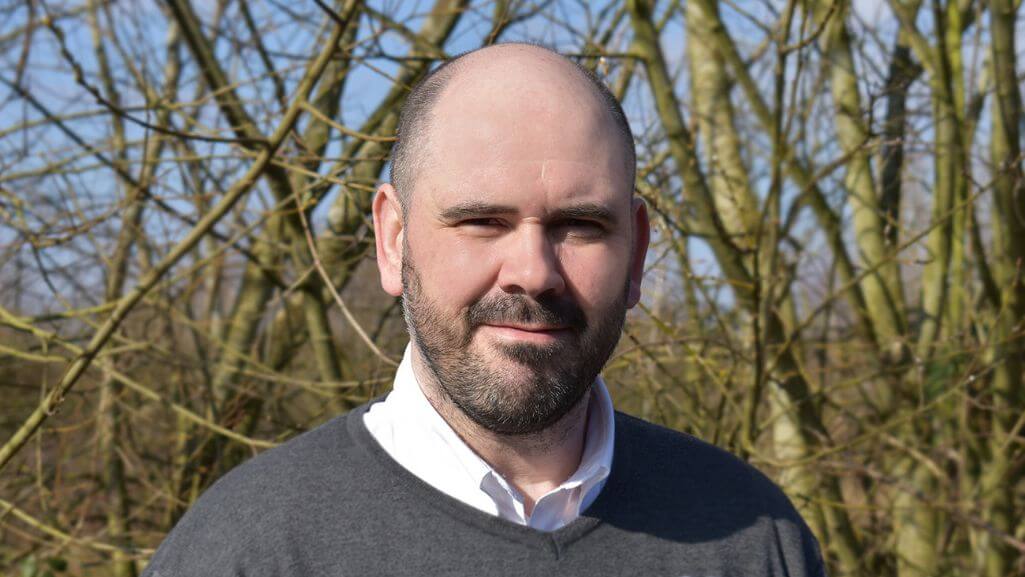
Antony Hare has been part of Farleygreene since 1993, when he joined as a machine fitter on the factory floor. Today, as Managing Director, he leads a business that operates in nearly 30 countries and has been designing and manufacturing industrial sieving equipment for 50 years. The journey through every department in the company, through periods of significant change, and through the personal challenge of taking over a family business at short notice, has shaped both the leader and the company he runs.
A business founded on engineering principle
Farleygreene was founded in 1976 by Antony’s father, Alan Hare, and his business partner Peter Davies. Both were chief design engineers who set out to build sieving equipment to a higher standard than the market was offering at the time. The founding principle was straightforward: engineer it properly, build it to last and stand behind it. That principle has not changed in 50 years of operation.
Antony did not initially plan to join the family business. When he did, his father made a deliberate decision to start him on the factory floor as a machine fitter, learning the product from the inside out. It was not always comfortable at the time, but it proved formative.
“My father never gave me an easy ride. He wanted me to understand how everything worked – the machines, the people, the process. Looking back, that was a great gift: a deep experience which helps me understand how to serve our customers better.”
Antony worked his way through every department, from design, testing and manufacturing, to sales, before taking on a leadership role. This breadth of hands-on experience underpins how he runs the business today.
Evolving the manufacturing model
In the early 2000s, Farleygreene moved to a subcontracted component model, sourcing fabricated parts from trusted local UK suppliers and carrying out final assembly at their Hampshire facility. Two decades later, the decision was made to bring fabrication progressively back in-house, for greater control over quality, lead times and cost. Today the workshop team has grown to seven, with continued investment in new tooling (including an imminent laser cutter) and the expectation of reaching approximately 70% in-house production. All manufacturing remains UK-based.
“The move back to in-house fabrication is about quality and control as much as cost. When your manufacturing team is in the same building as your engineers, problems get solved faster, and the product gets better. That’s good for us and good for our customers.”
Stepping up – and raising the standard
The 2008 financial crisis had created an opening for smaller, more responsive suppliers, as customers who had previously worked exclusively with larger manufacturers began looking for alternatives. When Antony stepped up to lead the business following his father’s sudden death in March 2010, Farleygreene was well placed to capitalise on that shift.
The following year brought one of the company’s most significant commercial breakthroughs. A French OEM (which later became part of the Tetra Pak group) tasked an engineering intern to explore alternative sieving suppliers internationally. They found Farleygreene, requested a quote, and worked closely with the team to develop a solution that met their requirements precisely. The result was addition to a key approved supplier list, which in turn opened the door to relationships with major global food manufacturers including Nestlé and Danone, and to a significant increase in OEM business.
“That period taught us a lot. Larger customers with demanding specifications found that we could match or exceed what they were getting elsewhere – and we were easy to work with. We respond fast, we are flexible, and when something needs solving, we solve it. That reputation has stayed with us.”
The episode also reinforced the company’s commitment to high-specification manufacturing as standard. Where some suppliers offer upgraded materials such as 316 grade stainless steel (required for all food-contact components) as premium option, Farleygreene’s baseline specification reflects what demanding customers actually need.
How Farleygreene works with customers today
The business today supplies sieving and screening equipment across food and drink, pharmaceutical, chemical, and additive manufacturing sectors. Orders range from standard configurations through to fully bespoke solutions designed for a specific application – some of which become the basis for new standard products. The engineering team’s experience across decades of applications means they can identify where a standard configuration needs adapting, and have the in-house capability to make those changes without compromising delivery or quality.
Every enquiry is supported by a material testing database built up over decades, allowing the team to predict how a specific product will behave on a given machine and advise accordingly. Customers frequently arrive with assumptions about their material (such as particle size, flow behaviour or bulk density) that testing reveals to be incomplete. Getting that right before the machine is specified saves considerable time and cost downstream.
“Customers often arrive with a specification based on what they think their product is. Our testing frequently reveals something different. Getting that right before the machine is built saves a lot of problems later.”
The engineering team works in SolidWorks, which has transformed both the design process and the customer experience. 3D models allow customers to visualise exactly how equipment will integrate into their production line before a machine is built, reducing installation surprises and speeding up internal approvals.
The six-step consultation process – from initial application request through to ongoing support – is designed to ensure nothing is assumed and nothing is missed. Farleygreene operates a structured follow-up process after every delivery to capture feedback and ensure the engineering team has visibility of real-world performance. When issues arise, they are tracked, addressed, and fed back into the product development process.
“When something goes wrong – as occasionally they do – the way we deal with it tells customers more about us than when everything runs smoothly. We take it seriously and work hard to be a company that’s there for customers for the long term, not just until the machine is installed.”
UK manufacturing, global reach
All Farleygreene equipment is designed and built in the UK, certified to ISO 9001, ATEX, CE, and UKCA standards, and supported by a global distributor network covering nearly 30 countries. For the large multinationals that now form a significant part of the customer base, UK manufacture and internationally recognised certification are precisely what their procurement standards require.
The company has also retained the scale and culture that allows it to work differently from larger competitors. Customer relationships are direct and long-standing – some customers have been with Farleygreene for decades. Decades of application experience mean the engineering team can identify where modifications are needed and make them in-house – without compromising on delivery or quality. The people making the decisions are the same people who built the product and know it in detail.
“We’ve spent 50 years earning the trust of some of the most demanding customers in the world,” confirms Antony. “In the sieving industry, experience and expertise are what that trust is built on – and we continue to demonstrate both.”
Find out more about Farleygreene
To learn more about Farleygreene’s history, products, and approach, visit the About Farleygreene page, explore the full sieving and screening product range, or contact the team to discuss your requirements.
About the author
Antony Hare is Managing Director of Farleygreene, a position he has held since 2010. He joined the company in 1993 and has worked across every department of the business. Connect with Antony on LinkedIn.