


Choosing the right industrial sieves for chemical powders is rarely as simple as matching a mesh to a target particle size. This is particularly true in chemical production, where powders may range from free-flowing materials to finer, dustier or more hazardous products that place different demands on the sieving stage.
In chemical manufacturing, sieve choice can affect product quality, contamination control, throughput and safe handling. This is why chemical sieve demands are best assessed in context. The right choice depends not only on the powder, but on what the sieve needs to achieve within the wider process. This article outlines the key factors that shape that decision, building on our Guide to Industrial Sieves.
Start by defining what the sifting process needs to achieve
Before looking too closely at the powder itself, it helps first to define the sieve’s specific function in the line. In some chemical applications, the aim is straightforward check sieving to remove oversize particles or foreign material. In others, the sieving step is there to improve consistency before blending, packing or further processing, or to protect downstream equipment from contamination or irregular particle size.
Industrial sieves for chemical powders are principally used for:
- Check sieving: removing oversize particles, foreign material or tramp metal
- Grading/Sizing: dividing material into multiple fractions for consistency
- De-agglomeration: breaking down soft lumps formed during storage or transit
- Downstream protection: protecting expensive mixers or packing machines from contamination.
Purpose matters because the same powder may demand a different solution in a different plant. One process may prioritise separation accuracy, another may need easier integration into the line. Throughput, line layout, batch changeovers, containment needs and access for cleaning can all influence what works best. In our experience, better decisions are made when the sieving step is defined by its role in the process first, and only then matched to the behaviour of the powder.

How powder characteristics affect sieve choice
Once the objective is clear, the next step is to look at how the powder is likely to behave in practice. Chemical powders are diverse. Common materials screened include inorganic chemicals like aluminium oxide, zinc powder and lead oxide, as well as speciality pigments and polymers. Some flow freely and sieve with relatively little resistance. Others agglomerate, cling to the mesh, generate dust or behave inconsistently as conditions change. These differences can affect throughput, screening efficiency and how reliably the sieve performs over time.
Fine chemical powders
Fine powders often need particularly careful assessment because as particle size reduces, the risk of mesh blinding and reduced efficiency can increase. Where sieve screen apertures become obstructed by particles, the clogged or blind surface prevents proper material separation, which can result in more frequent stoppages for cleaning.
In some applications, ultrasonic de-blinding can help keep the apertures clear and support more consistent powder movement across the screen without introducing unnecessary interruption into production. Farleygreene’s ultrasonic system is designed to fit within most Sievmaster sieving machines. The Sievmaster Ultrasonic System applies high frequency, very low amplitude vibration to the mesh screen, helping to deblind and fluidise fine product so that it can be screened more easily.
Hazardous chemical powders
For many chemical manufacturers, safety is the primary driver. If you handle combustible dusts (like certain resins or metal powders), compliance with DSEAR (Dangerous Substances and Explosive Atmospheres Regulations) is a legal requirement in the UK. Employers must perform a risk assessment to classify hazardous zones (e.g., Zone 21 or 22) and ensure all equipment is ATEX-certified.
Chemical powders that are hazardous, potentially harmful or prone to dust generation may further change the specification as the sieve may need to do more than separate the material accurately: it may also need to support containment, enclosed handling and suitable integration into the wider process to support a safer, cleaner and more controlled operation.
For example, to overcome the issue of dust generated from airborne powders, Farleygreene has developed the Vacusiev range. This range of vibratory check screeners screens toxic, very fine, or dusty material within vacuum or pneumatic conveying systems. The Vacusiev range is:
- Rated ATEX zone 21 II 2 D
- Suitable for wet or dry applications
- Dust and waterproof to at least IP65
The way the material behaves during sieving can be a strong factor when choosing a sieve for processing chemical powders.
Which sieving approach is right for the application?
Once the role of the sieve and the behaviour of the powder are understood, the next question is which chemical sieving solution is best suited to the application.
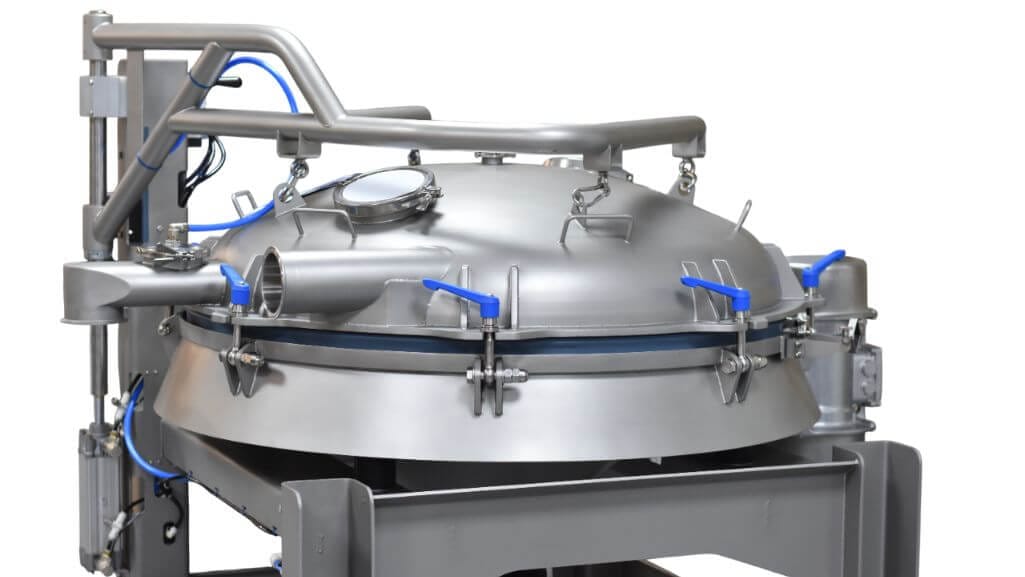
Vibratory sieves are used in chemical powder applications where the priority is accurate separation, removal of oversize material, or reliable screening across a range of applications. They are well suited to applications where maintaining a defined separation is central to product quality or downstream process control. Farleygreene’s highly effective vibratory sieves use powerful, controlled vibrations to help you achieve accurate separation of chemical powders.
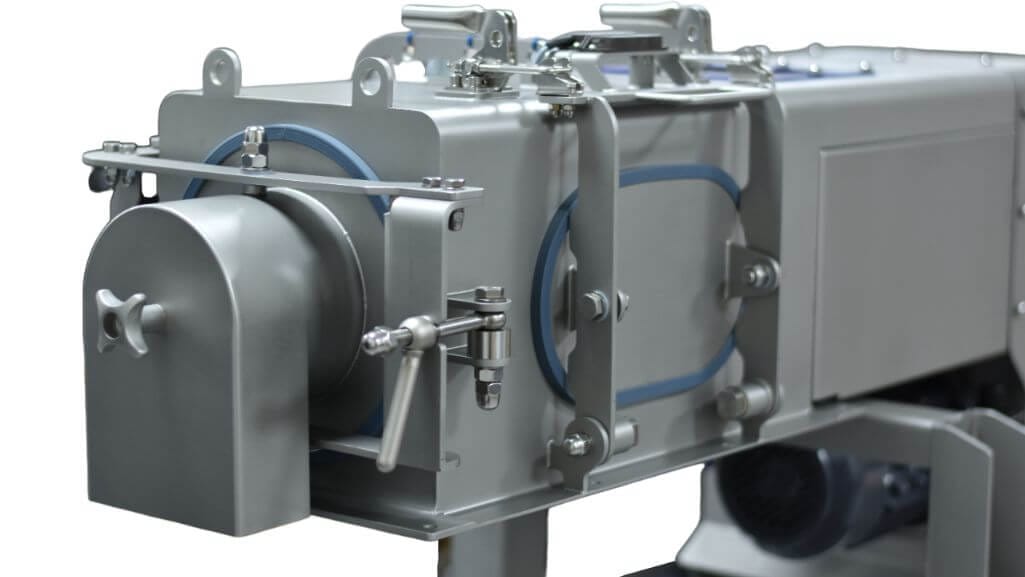
Centrifugal sieves can be a better fit where the material is lumpy, cohesive or compacted. Using internal rotating paddles, they break down lumps and are perfect for enclosed processing. Because centrifugal sieves are compact and horizontal, they integrate seamlessly into closed transfer systems such as vacuum or pneumatic conveying lines. This makes them particularly suitable for sieving fine, dusty or potentially harmful powders, and applications where containment and controlled product flow are key considerations.
The choice also depends on how the sieving stage fits into the wider line. In some cases, the priority is separation accuracy. In others, it is easier product handling, better containment or smoother integration with upstream and downstream equipment. That is why there is rarely one universally best option: the right choice depends on the role of the sieve, the behaviour of the powder and the practical demands of the process around it.
Why cleaning and access matter in chemical sieving
Cleaning and access can have a direct effect on both product quality and day-to-day efficiency. In chemical production, where powders may vary from batch to batch or where contamination between runs needs to be controlled carefully, a sieve that is awkward to clean can create avoidable risk as well as unnecessary downtime. If access to the sieve for inspection, cleaning or routine maintenance is difficult, those jobs take longer and are more likely to disrupt production. This is especially important in processes with frequent changeovers or tighter cleaning requirements, where lost time can quickly affect output.
Farleygreene sieves for chemical applications are designed for quick access and effective cleaning, supporting product quality and sieve efficiency:
Tool-free strip down
Our machinery is designed to be stripped down for cleaning without the need for specialist tools. This includes easily removable seals and a minimal-crevice design to prevent product “trap points”.
WIP capabilities
For applications involving hazardous or highly active powders, our systems support Wash-In-Place (WIP). WIP allows the internal chamber to be wetted down before opening, suppressing dust and protecting operators.
IP65 Protection
To support these rigorous wash-down regimes, our units are dust and waterproof to at least IP65, ensuring electrics and drive systems are fully protected during high-pressure cleaning.
Mirror polished surfaces
To support contamination control and batch integrity, we offer high-grade internal and external polishing to <0.25Ra, making surfaces easier to validate during cleaning cycles.
Material specification
To ensure maximum corrosion resistance and longevity, all contact parts are manufactured from 316 Stainless Steel (1.4401). For durability and hygiene in non-contact areas, we utilise 304 Stainless Steel (1.4301).
Case study: bespoke sieve for chemical manufacturer
At Farleygreene, we work with customers to design sieves that will meet their cleaning and access requirements. In this case, we developed a bespoke sieve for a chemical manufacturer. A sieve for the removal of over-sized product from black printer toner had to be easy to dismantle for cleaning, and required dust tight seals due to the nature of the powder. Competitors’ machines had not proved suitable, but Farleygreene was able to adapt a Sievmaster 700-ST unit for trial with outstanding success.
For chemical manufacturers, it is clear that thinking about how the sieve will work in the realities of daily operation is a key step in sieve trial and selection.
Compliance and traceability also influence the decision
Sieving decisions for chemical processing in the UK may also require compliance with GB REACH and stringent traceability standards (e.g., batch tracking) to manage safety and regulatory duties. Where batch integrity, hazard communication and contamination control matter, manufacturers need systems and records that support clear identification of materials, reliable process control and consistent cleaning between runs.
Farleygreene provides sieving systems suitable for chemicals industry applications, offering a range of solutions that address the challenges of powder handling, hygiene and compliance standards.
The right sieve is the one that fits the process
Choosing an industrial sieve for chemical powders is rarely about one factor alone. In practice, the best solution depends on what the process needs to achieve, how the powder behaves, and what daily production demands in terms of containment, cleaning, throughput and access. That is why sieve selection often becomes less reliable when it is reduced to particle size, or one headline performance figure, in isolation.
At Farleygreene, we have the expertise to supply bespoke chemical sifting units to meet individual demands. For example, our Case Study on sieving explosive chemicals demonstrates how we designed a centrifugal sifter unit on a bespoke support frame for a major agrochemical manufacturer. The check sieve unit was nitrogen purged to overcome any explosive risks and was fitted ‘in-line’ to a sealed mixer system.
With extensive experience in industrial sieving, Farleygreene helps chemical manufacturers assess all relevant factors, so the chosen solution suits the realities of the process, not just the specification on paper. For suppliers working with fine, dusty or more difficult powders, this can help reduce risk earlier, improve confidence in the chosen approach and support more reliable performance in day-to-day operation.
Talk to Farleygreene about your chemical sieving application.
…………………………………………………………………………………………………………………………………………………………………………………………………………………………………………………………………..
FAQs about industrial sieves for pharmaceutical powders
1. How do I choose the right sieve for chemical powders?
Choose the sieve based on what the sieving step needs to achieve, how the powder behaves, and how the unit will fit into the wider process. In chemical applications, the right choice often depends on whether the priority is contamination removal, particle size control, containment, cleanability, or downstream process protection.
2. Why are fine chemical powders harder to sieve?
Fine chemical powders are often harder to sieve because they are more prone to mesh blinding, inconsistent flow and reduced screening efficiency.
3. When should ultrasonic deblinding be used in chemical sieving?
Ultrasonic deblinding is most useful when very fine powders are blocking the mesh and reducing throughput or consistency. It can be valuable where fine material needs help moving consistently across the screen and keeping apertures clear.
4. What is the difference between vibratory and centrifugal sieving for chemical powders?
Vibratory sieves are commonly used where the priority is accurate separation or removal of oversize material, while centrifugal sieving can be a better fit where the material is lumpy or compacted, or where enclosed processing is important.
5. Do hazardous or dusty chemical powders need a contained sieving system?
Often, yes. Chemical powders that are hazardous, potentially harmful or prone to dust generation may require a more contained sieving approach, with enclosed handling and suitable integration into the wider process to support safer, cleaner and more controlled operation.
6. Why do cleaning and access matter when choosing a chemical sieve?
Cleaning and access matter because they affect contamination control, batch changeovers, downtime and day-to-day reliability. A sieve that is difficult to inspect or clean may slow production and increase the risk of inconsistent cleaning between runs.