


By Daniel Morlan, Global Sales Manager, Farleygreene
Nutraceuticals (including health supplements, protein powders, vitamins and minerals, sports nutrition, and botanical extracts) is one of the fastest-growing sectors in food manufacturing: according to Grand View Research, the global nutraceuticals market was valued at $636.2 billion in 2025 and is projected to grow at a CAGR of 7.7% through to 2033. Represented in the UK by the Health Food Manufacturers’ Association (HFMA), the sector brings together a wide range of manufacturers whose products share one common demand: precise, hygienic powder processing at every stage of production.
For production teams, that growth brings a constantly expanding range of materials to process, many of which behave very differently from conventional food powders. Fine, sticky, hygroscopic, and often electrostatically charged, nutraceutical powders present sieving challenges that catch many manufacturers off guard, especially those scaling up from manual or small-batch production for the first time. This guide covers what makes these materials difficult to sieve, how to solve the most common problems, and how to choose the right equipment for your process.
Why nutraceutical powders are harder to sieve than most people expect
Nutraceutical powders present a particular challenge because of the combination of properties that make them behave unpredictably on a conventional sieve mesh. Understanding what is happening at the mesh level is the first step to solving it.
Hygroscopicity
Many nutraceutical ingredients absorb moisture from the air and form hard agglomerates during storage. Protein powders, collagen, greens blends and many botanical extracts are particularly prone to this. This is because proteins, peptides and many plant-derived compounds contain polar groups that readily bond with atmospheric water molecules, while their fine, high surface-area particle structure provides greater exposure to moisture. What arrives at the sieve as a bulk powder may contain lumps that need breaking down before screening can be effective.
Fine particle size
A large proportion of nutraceutical powders have target particle sizes below 500 microns – some considerably finer. At these sizes, particles have a high surface area relative to their mass, which makes them prone to sticking to each other and to the mesh wires rather than passing through apertures cleanly.
Static charge
Fine powders generated by milling or spray drying often carry an electrostatic charge. This causes particles to cling to mesh surfaces and to each other, compounding the blinding effect. Vitamin premixes, plant-based protein isolates, and certain botanical extracts are particularly prone to this behaviour.
Natural oils and fats
Ingredients like vanilla powder, cocoa and many botanical extracts contain natural oils that cause particles to smear across mesh apertures rather than passing through cleanly. This is one of the most persistent causes of mesh blinding in nutraceutical applications, and one that standard vibratory sieving alone often cannot resolve.
Variability between batches and suppliers
Unlike manufactured pharmaceutical excipients, nutraceutical raw materials can vary in particle size, moisture content and flowability from batch to batch and supplier to supplier. In my experience working with nutraceutical manufacturers, the range of powders that come through our test facility is wider than in almost any other sector: a customer might be sieving whey protein one week and a superfood blend the next, and each behaves completely differently on the mesh. A sieve specification that works well for one delivery may underperform on the next, and customers who specify a machine on paper rather than trial it with their actual product are the ones most likely to run into difficulty. This variability makes pre-purchase testing with your actual material particularly important.
How ultrasonic sieving solves the mesh blinding problem
Mesh blinding happens when particles block the apertures of a sieve mesh, reducing the open area available for product to pass through. As blinding progresses, throughput falls, oversize material accumulates on the mesh, and sieving efficiency drops – sometimes to the point where the machine needs to be stopped and the mesh cleaned manually. For nutraceutical manufacturers running multi-product lines, unplanned stoppages for mesh cleaning are a significant operational cost. Our guide to the five benefits of using ultrasonics on your sieving machine covers the technical detail, but the key point for nutraceutical applications is this: conventional vibratory sieving alone is often not enough.
Ultrasonic deblinding: the most effective solution for fine nutraceutical powders
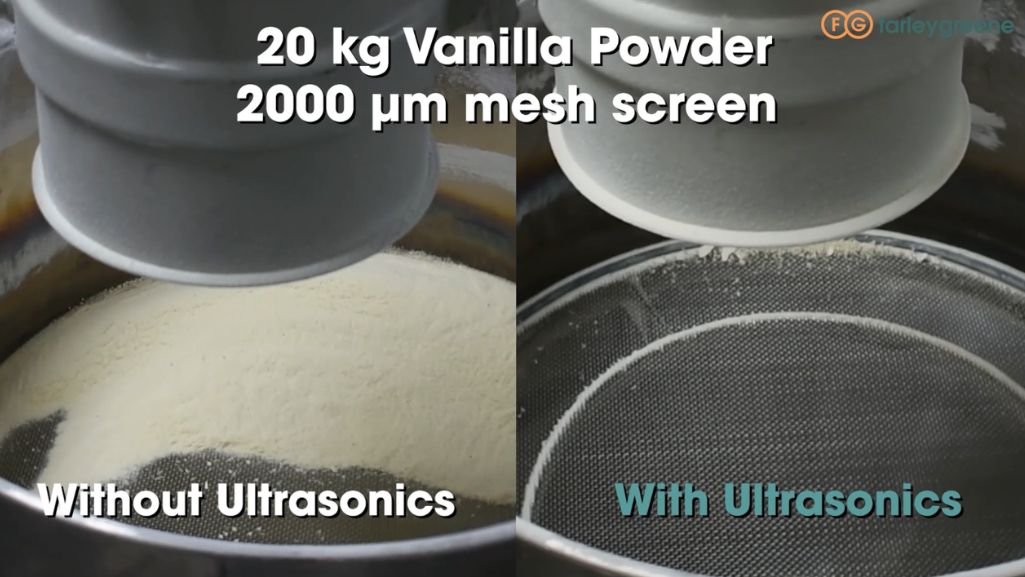
An ultrasonic deblinding system works by applying a high-frequency, low-amplitude vibration directly to the mesh surface. This continuous micro-movement breaks the surface tension between sticky or static-prone particles and the mesh wires, keeping apertures clear without manual intervention. The result is consistent throughput even with the most difficult nutraceutical powders.
The practical impact can be significant. In one application, a global manufacturer of fine vanilla powder (a material with high natural oil content that causes severe mesh blinding on a conventional sieve) trialled a Sievmaster Ultrasonic System at our Hampshire test facility before committing to a purchase. The results showed a throughput increase of up to 50% compared to their existing setup, with a simultaneous reduction in product waste from over-retained good material. Read the full vanilla powder case study.
Environmental controls
Controlling humidity and temperature in the screening area reduces hygroscopic blinding significantly. Keeping relative humidity below 40% makes a measurable difference for protein powders and botanicals that absorb moisture quickly. This is a low-cost first step that complements rather than replaces the mechanical solutions above.
Sieving at every stage of nutraceutical production
Sieving is rarely a single step in a nutraceutical production process. Different stages of production create different sieving requirements, and the right machine for incoming raw material check screening may not be the right machine for pre-pack quality control or capsule fill grading.
Incoming raw material check screening
Incoming botanical extracts, protein powders, vitamin premixes and other bulk ingredients need verification screening to remove foreign bodies, oversize agglomerates and any contaminants introduced during transit or storage. The Slimline range of vibratory check sieves is the most widely used Farleygreene product for this application – hygienic, easy to strip down for cleaning, and available with ultrasonic deblinding for sticky or fine materials.
Deagglomeration of hygroscopic powders
Protein powders, collagen and many botanical ingredients that have agglomerated in storage need the agglomerates broken down before blending or filling. Centrifugal sieving via the Rota range is effective here, applying centrifugal force to break down compacted material and push it through the mesh cylinder. For fragile or friable ingredients where the mechanical action of centrifugal sieving could cause product damage, a vibratory check sieve with ultrasonic deblinding is the more appropriate choice.
Particle size grading for capsule and sachet fill
Accurate dosing and batch uniformity in capsule or sachet filling depends on consistent particle size distribution. The Multiscreen range grades powders into precise size fractions through up to four mesh stages in a single pass. This is particularly relevant for nutraceutical manufacturers supplying products where label-claim accuracy must be demonstrably consistent across every batch.
Pre-pack quality control
A final check sieve before packing removes any oversize material, agglomerates or foreign bodies that may have been introduced during blending or filling. The Slimline range with tool-free mesh change and crevice-free internals is the standard recommendation here, keeping changeover time between products to a minimum.
Small batch and new product development
New Product Development (NPD) Managers and formulation teams trialling new products or ingredients at small scale need compact, easy-to-clean sieves that can be switched between materials quickly without cross-contamination risk. The Sievmaster 200-S and 500-S batch sieve ranges are designed for exactly this, with a small footprint, straightforward operation, and accessible enough for a lab or pilot production environment. They are also the natural starting point for manufacturers scaling up: beginning on a 200-S or 500-S and progressing to a full Slimline production sieve as volumes grow.
Allergen control and multi-product changeover
Many nutraceutical manufacturers process a wide range of ingredients on the same equipment, including protein powders from multiple sources, botanical blends, mineral premixes, and finished supplement formulations. Where allergen-containing ingredients are involved, the consequences of inadequate changeover procedures can be severe. Whey protein, soy protein isolates, shellfish-derived glucosamine, and tree nut extracts are all common in nutraceutical production, and undeclared allergens are a leading cause of food product recalls.
Farleygreene sieves are designed to make thorough, verifiable changeovers as straightforward as possible. Internal surfaces with minimal crevices eliminate the hidden traps where product residue accumulates between runs. Stainless steel contact parts polished to a low Ra surface finish are easier to clean and inspect. Tool-free mesh removal means screens can be taken out, cleaned and replaced without specialist tools or extended downtime.
For facilities processing major allergens alongside non-allergen products, maintaining dedicated screen sets labelled by allergen type is best practice. The Food Standards Agency allergen guidance sets out the requirements for food businesses handling the 14 regulated allergens.

Compliance, documentation, and protecting your brand
Nutraceutical manufacturers selling into health and wellness markets have built their commercial reputation on product purity and quality. That reputation depends on every stage of the manufacturing process being defensible: not just the formulation, but the equipment used to process it.
For manufacturers operating under the US dietary supplement framework, including those subject to the good manufacturing practice requirements of 21 CFR Part 111, sieving must function under documented process control with a verifiable audit trail.
For manufacturers supplying the UK and EU markets, food supplements are regulated under Directive 2002/46/EC, alongside the general food hygiene and GMP requirements of regulation (EC) 852/2004. As with the US framework, the underlying expectation is the same: a documented, verifiable process from raw material through to pack.
Beyond the regulatory requirement, there is a straightforward commercial argument. A quality claim made on a product label is only as credible as the manufacturing process behind it. Equipment that enables consistent, documented changeovers and meets hygienic design standards is part of what makes that claim defensible to customers, certification bodies and regulators alike.
Handling fine, static prone powders safely
The same fine particle size and static charge that make nutraceutical powders difficult to sieve also mean some of these materials, such as protein isolates, botanical powders, and certain starches, can present a combustible dust risk when suspended in air in sufficient concentration. This is a key reason equipment specification in this sector should account for ATEX zone classification alongside throughput and mesh selection. Farleygreene equipment is available to ATEX specification for use in classified areas handling combustible powders.
Scaling up: what changes when you move from small batch to industrial production
A significant proportion of nutraceutical manufacturers come to Farleygreene at a point of transition, moving from manual sieving or small-batch production into their first industrial-scale system. The step change in volume brings sieving challenges that simply do not appear at smaller scales.
Throughput requirements change the machine specification
A sieve that handles 50kg per hour comfortably may quickly become a bottleneck at 500kg per hour. Industrial throughput requires attention to mesh open area, machine diameter, and whether continuous or batch processing is appropriate for your line. Getting this wrong at the specification stage is a costly mistake.
Material behaviour can change at scale
Powders that flow freely in a small lab sieve sometimes behave very differently when fed continuously into a larger machine at production volumes. Heat generated by continuous operation, changes in feed rate, and the pressure of deeper powder beds on the mesh can all affect performance in ways that small-scale trials do not reveal.
Continuous vs batch processing
Small-batch production typically uses batch sieves: the product is loaded, the machine runs until complete, and the oversize is retained for inspection. Industrial production lines usually require continuous processing, where product flows through the sieve as part of an uninterrupted line. The machine type, feed arrangement and discharge configuration are all different, and moving from one to the other requires a fresh specification rather than simply scaling up the existing approach.
Integration with the wider production line
At industrial scale, the sieve connects to upstream feeding equipment, downstream filling or blending machinery, and in some cases to pneumatic conveying systems. Our Vacusiev range integrates sieving with pneumatic conveying in a single dust-tight operation, which is particularly relevant for fine or dusty nutraceutical powders where product loss and operator exposure are concerns. For more on dust management in powder processing, see our blog on vibratory sieving dust containment and control.
Real performance data, before you commit
Generic specifications for nutraceutical sieving are rarely reliable. Particle size, moisture content, flowability, and static behaviour all vary between different materials, and often between different batches of the same material. The only dependable basis for a sieve purchase is a trial with your actual product on the proposed equipment.
Our specialist test facility in Hampshire has been running customer trials since 2014. Bring your material to us, or hire a machine to trial at your own site, and our test engineer will work with you to determine the right mesh specification, machine configuration, and deblinding approach for your specific powder before you commit to a purchase. The vanilla powder manufacturer whose case study is referenced above took exactly this approach, identifying and validating a 50% throughput improvement at our Hampshire facility before a single machine was ordered.
For nutraceutical manufacturers processing multiple ingredients with different characteristics, we can run sequential trials to identify a machine configuration that performs across your full product range, rather than optimising for a single material.
Why nutraceutical manufacturers choose Farleygreene
- UK-designed and built since 1976, with over five decades of experience in regulated and quality-critical processing industries
- A full range of sieving technologies: check sieving, grading, centrifugal, ultrasonic, small batch, and pneumatic, covering every stage of nutraceutical production, all from a single supplier
- Specialist test facility in Hampshire with hire-to-trial option, so performance is validated before purchase
- Hygienic design as standard: minimal internal crevices, stainless steel contact parts, tool-free disassembly, and metal-detectable components for allergen-sensitive production environments
- Designed to support compliance with FDA requirements
- Certified to CE, UKCA, ATEX and ISO 9001, with full documentation to support your quality management system and any export compliance requirements
- Global distributor network for local installation, commissioning, and aftersales support
If you are dealing with mesh blinding, scaling up production, or specifying a sieve for a material you have not processed before, we are happy to talk it through. Contact me and the team or book a trial at our Hampshire facility.
About the author
Daniel Morlan is Global Sales Manager at Farleygreene, where he has spent over a decade working with manufacturers across the food, pharmaceutical, chemical, and nutraceutical sectors to specify the right sieving solution for their process. With a background spanning industrial manufacturing and international sales, Daniel brings direct application knowledge to every customer enquiry. Read Daniel’s full profile or connect on LinkedIn.
…………………………………………………………………………………………………………………………………………………………………………………………………………………………………………………………………..
FAQs
1. Why do nutraceutical powders blind sieves more than other materials?
Nutraceutical powders blind sieves more readily than most materials because they combine several problematic properties at once: fine particle size, hygroscopicity, static charge, and natural oil content. Fine particles below 500 microns have a high surface area relative to their mass, making them prone to sticking to mesh wires rather than passing through cleanly. Hygroscopic ingredients like protein powders and botanicals absorb moisture and clump together. Static charge, common in spray-dried and milled powders, causes particles to cling to mesh surfaces. Natural oils in vanilla, cocoa, and botanical extracts smear across apertures rather than passing through. Any one of these properties can cause blinding; many nutraceutical powders have two or more simultaneously.
2. What is ultrasonic sieving and how does it help with sticky powders?
Ultrasonic sieving applies a high-frequency, low-amplitude vibration directly to the mesh surface, separate from the main vibratory motion of the sieve body. This continuous micro-movement breaks the surface tension between sticky or static-prone particles and the mesh wires, preventing apertures from blocking and keeping throughput consistent. It is the most effective solution for fine, oily, or electrostatically charged nutraceutical powders, and can be retrofitted to most existing Sievmaster machines as an add-on system. For severe blinding caused by natural oils or very fine particle sizes, ultrasonics is the only reliable mechanical solution.
3. How do I choose between a vibratory sieve and a centrifugal sifter for nutraceutical powders?
Vibratory sieves are the better choice for delicate or friable ingredients where gentle handling is important, including capsule-fill blends, probiotic powders, and products where particle integrity affects dosage accuracy. Centrifugal sifters are more appropriate for breaking down agglomerates in hygroscopic materials like protein powders and collagen that have clumped in storage, where the higher mechanical energy is an advantage rather than a risk. For most nutraceutical check screening and quality control applications, a vibratory sieve with ultrasonic deblinding covers the majority of requirements and is the configuration we most commonly recommend for this sector.
4. Can the same sieve be used for allergen and non-allergen products?
Yes, provided the right changeover procedure and documentation are in place. Farleygreene sieves are designed for fast, thorough clean-down between product runs: crevice-free construction eliminates residue traps, stainless steel contact parts with a fine surface finish support cleaning validation, and tool-free mesh removal allows screens to be changed quickly without specialist equipment. For facilities processing major allergens such as whey, soy, or shellfish-derived ingredients alongside non-allergen products, maintaining dedicated screen sets labelled by allergen type is best practice.
5. How do I know what mesh size I need for my nutraceutical powder?
Mesh size selection for nutraceutical powders depends on three factors: your target particle size distribution, the percentage of oversize in your incoming material, and your required throughput and sieving efficiency. For check sieving applications the aperture is typically set at two to three times the target particle size, removing agglomerates and foreign bodies while passing good product freely. For grading applications the specification is more precise and needs to be validated against your actual material. The most reliable way to confirm the right mesh size is to trial your powder at our Hampshire test facility, where our test engineer can test across multiple aperture sizes and recommend the optimal configuration for your process.